Foundation Inspections in Fort Collins & Northern Colorado
Your home’s foundation is the most structurally critical component of the entire building. Every wall, floor, roof, window, and door depends on the foundation to remain stable, level, and intact. When foundation problems develop, they rarely announce themselves with sudden dramatic failure. Instead, they progress gradually through symptoms that are easy to misread, misattribute, or dismiss as cosmetic issues until the underlying structural situation has advanced to a point where repairs are significantly more complex and expensive than they would have been with earlier detection and intervention.
At Fort Collins Foundation Repair, our foundation inspection service provides a thorough, systematic, and professionally documented assessment of your home’s foundation condition. We evaluate every accessible aspect of the foundation, from the exterior perimeter and visible wall surfaces to the interior basement or crawl space conditions, the floor levels above, and the site drainage patterns that directly influence how the foundation performs over time. Our inspectors bring a deep understanding of the specific soil conditions, construction practices, and climate factors that drive foundation problems in Northern Colorado, and they interpret every finding in that local context to give you an accurate picture of what you are dealing with and what it means for your home.
We serve homeowners throughout Fort Collins, Loveland, Greeley, Windsor, Wellington, Timnath, and the surrounding communities of Larimer and Weld counties. Whether you are concerned about cracks you have noticed, preparing to buy or sell a property, following up on a general home inspection that flagged foundation concerns, or simply wanting to establish a baseline understanding of your foundation’s current condition, our inspection service gives you the accurate, documented information that every well-informed homeowner needs.

Why a Professional Foundation Inspection Is Essential for Northern Colorado Homeowners
Northern Colorado’s soil conditions create a foundation environment that is among the most demanding in the region. The expansive clay soils that dominate the geology throughout Larimer and Weld counties absorb water and swell significantly when wet, then shrink and crack when they dry out. This constant volumetric cycling exerts lateral and vertical forces against foundation walls and footings that vary dramatically with the seasons, placing a type of cyclical stress on foundation structures that does not occur in regions with more stable, non-expansive soils. Over years and decades, this stress produces cracking, movement, and structural displacement that can be subtle in its early stages but progressive and compounding if not identified and addressed appropriately.
The Front Range also experiences a freeze-thaw cycle that contributes to foundation deterioration in ways that are separate from soil movement. Water that has permeated into small cracks in foundation concrete freezes during cold weather and expands, widening cracks with each cycle. Over multiple winters, cracks that began as hairline fractures can develop into significant structural pathways for water infiltration and zones of genuine structural weakness. The number of freeze-thaw cycles a foundation in Fort Collins experiences in a single winter season is sufficient to produce measurable crack propagation in compromised concrete over relatively short timeframes.
Foundation problems also have a way of manifesting in the living space in forms that homeowners often attribute to other causes. Doors and windows that stick or no longer close properly. Cracks in drywall at corners of door and window openings. Floors that feel uneven or slope noticeably in one direction. Gaps forming between walls and ceilings or between walls and floors. These symptoms are frequently dismissed as normal settling, cosmetic aging, or humidity-related wood movement when they are actually indicators of foundation movement that warrants professional evaluation.
A professional foundation inspection from Fort Collins Foundation Repair connects these symptoms to their structural causes, evaluates the severity and progression rate of any movement identified, and gives you accurate information about the nature of what is happening and what level of response it warrants. That information is the essential first step for any homeowner navigating foundation concerns.
Signs You Should Schedule a Foundation Inspection
- Cracks in foundation walls, whether horizontal, vertical, diagonal, or stair-step patterns
- Basement or crawl space walls that appear to be bowing or leaning inward
- Cracks in interior drywall, particularly at corners of door and window openings
- Doors or windows that have begun sticking, binding, or no longer closing and latching properly
- Floors that feel uneven, slope noticeably, or have developed soft or bouncy areas
- Gaps forming between walls and ceilings or between walls and floor surfaces
- Visible separation between the chimney and the main structure of the home
- Cracks in exterior brick, stone, or stucco veneer, particularly diagonal cracks at corners
- Water intrusion through foundation wall cracks or at the floor-wall joint
- A general home inspection or appraisal report that flagged foundation concerns
- You are buying or selling a property and want an independent specialist assessment
- The home is located in an area with known expansive soil conditions or drainage issues
- The home has not had a foundation assessment in several years and you want to establish current baseline conditions
- Neighbors or nearby properties have experienced foundation problems that may indicate area-wide soil conditions
Many of these signs appear gradually and are easy to normalize over time. A professional inspection removes the guesswork and gives you accurate information about whether what you are seeing warrants concern and action.
Schedule Your Free Foundation Inspection
Fill out the secure form below to request your free foundation inspection. Our team will contact you promptly to schedule a convenient time to conduct a thorough assessment of your foundation from the exterior perimeter to the interior basement or crawl space. We document all findings with photographs and measurements, provide a written inspection report, and walk you through every finding in plain language. There is no cost and no obligation involved in requesting your inspection.
What Our Foundation Inspection Covers, Step by Step
A professional foundation inspection is a multi-phase assessment that examines every accessible aspect of the foundation system, from the site conditions that affect foundation performance to the structural condition of the foundation itself and the symptoms that its movement or deterioration has produced in the home above. Our inspection process follows a defined sequence that ensures nothing is overlooked and that every observation is placed in the context of the complete picture rather than evaluated in isolation.
Foundation problems are rarely caused by a single factor. The soil type, site drainage, the age and construction method of the foundation, the history of moisture exposure, the tree and vegetation proximity, and the maintenance history of the drainage and grading around the home all interact to produce the conditions that a foundation inspection reveals. Our inspectors are trained to read all of these factors together and to explain how they relate to the findings documented during the assessment.
We use calibrated instruments where appropriate, including floor level measuring tools, crack width gauges, and moisture meters, to provide objective measurements that supplement and support the visual assessment. These measurements give you data that can be used as a baseline for monitoring progression over time, which is particularly valuable when findings indicate that a foundation is experiencing active movement that warrants periodic re-evaluation rather than immediate repair.
Every inspection concludes with a detailed written report, photograph documentation of all notable findings, and an in-person walkthrough that covers every item in the report, explains what it means in plain language, and provides honest recommendations for next steps prioritized by urgency and importance.
- Pre-inspection homeowner consultation: Discuss symptoms observed in the living space, any previous foundation work or repairs, the history of drainage or moisture issues at the property, and specific areas of concern you want the inspection to address. This context ensures that the inspection is focused appropriately from the start.
- Site and exterior drainage assessment: Evaluate the grading around the home’s perimeter to determine whether soil slopes toward or away from the foundation. Assess downspout discharge locations and extension adequacy. Identify any landscape features, irrigation patterns, or surface drainage conditions that concentrate water near the foundation. Note the proximity and species of trees and large shrubs that may influence soil moisture conditions through root activity and transpiration.
- Exterior foundation wall inspection: Walk the full exterior perimeter of the foundation, examining all visible foundation surfaces for cracks, spalling, efflorescence, moisture staining, bulging, and displacement. Measure and document the width, length, orientation, and pattern of all cracks found. Note the construction type of the foundation, whether poured concrete, concrete block, stone, or other material, as construction type influences the interpretation of observed conditions.
- Exterior above-grade symptom assessment: Examine the exterior of the home above the foundation for symptoms that indicate foundation movement, including diagonal cracks in brick or stucco veneer, separation at corners or at the chimney, misaligned window and door frames, and gaps between siding materials and trim elements that suggest differential settlement or lateral movement.
- Interior living space symptom assessment: Move through the interior of the home observing and documenting all symptoms consistent with foundation movement. This includes cracks in drywall at door and window corners, doors and windows that stick or do not operate properly, gaps at wall-ceiling and wall-floor junctions, visible floor slopes and unevenness, and separation between structural elements that should be in continuous contact. Floor level measurements are taken with a precision level at multiple points throughout the home to map any settlement or heave patterns.
- Basement or crawl space interior wall inspection: Enter the basement or crawl space and conduct a close-range inspection of all interior foundation wall surfaces. Assess crack patterns in detail, noting whether cracks are consistent with shrinkage, lateral pressure, settlement, or heave. Measure crack widths at multiple points and assess whether crack geometry indicates active movement or historical stabilized cracking. Look for evidence of previous crack repairs that may indicate a history of movement the current owner may not be aware of.
- Foundation wall bowing and deflection measurement: Where walls show signs of inward deflection, use a straightedge or laser level to measure the degree of bow at the point of maximum deflection. Document the location and degree of bowing for each affected wall section. This measurement is critical for determining whether bowing has progressed to a threshold that requires structural intervention or whether it is within a range that can be monitored and stabilized with less invasive measures.
- Footing and foundation base assessment: Where accessible, assess the condition of the foundation footing and the base of the foundation wall for erosion, undermining, settlement, and the adequacy of soil bearing support. Identify any areas where soil has pulled away from the foundation base or where erosion has created voids beneath the footing that compromise the foundation’s bearing capacity.
- Water intrusion and moisture history assessment: Identify all locations where water has entered or is currently entering the basement or crawl space through the foundation walls or floor. Document tide marks, staining, efflorescence, and rust patterns that reveal the history and severity of moisture intrusion events. Assess whether current moisture conditions are consistent with active water management problems that are contributing to the foundation deterioration observed.
- Structural framing connection assessment: Where accessible, assess the condition of the connection between the foundation and the structural framing of the home above, including the sill plate anchor bolt condition, the rim joist integrity, and the continuity of the structural load path from the floor framing into the foundation wall and footing below.
- Written report, documentation, and homeowner walkthrough: Compile all findings into a comprehensive written inspection report with photographs, measurements, crack pattern diagrams where appropriate, and prioritized recommendations. Walk the homeowner through every finding in the report, explain what each observation means in plain language, distinguish between conditions that require prompt attention and those that can be monitored, and provide honest guidance on recommended next steps without pressure or alarm beyond what the findings genuinely warrant.
Foundation problems do not resolve on their own and rarely stay stable over time without intervention. The earlier they are identified and accurately assessed, the more options are available for addressing them effectively. A professional foundation inspection from Fort Collins Foundation Repair gives you the complete picture you need to make informed decisions about your home’s structural health. The inspection is free and there is no obligation to proceed with any repair work.
Schedule Your Free Foundation InspectionFoundation Inspection Findings Across Fort Collins & Northern Colorado
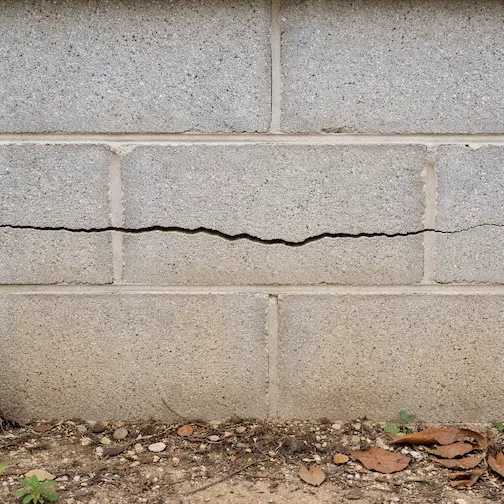
Inspection finding: Horizontal crack running the full length of a concrete block basement wall, indicating significant lateral soil pressure requiring structural stabilization.
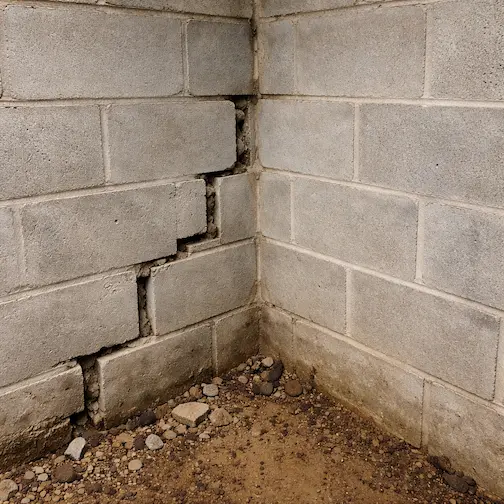
Inspection finding: Stair-step cracking pattern in a concrete block wall corner consistent with differential settlement in the clay soil beneath the footing.
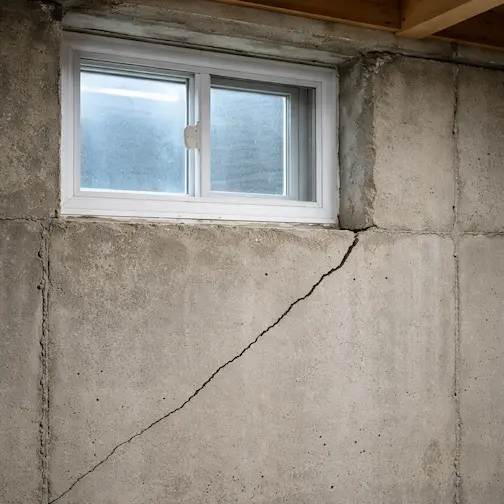
Inspection finding: Diagonal crack propagating from the corner of a basement window opening in a poured concrete wall, consistent with settlement stress concentration at a structural discontinuity.
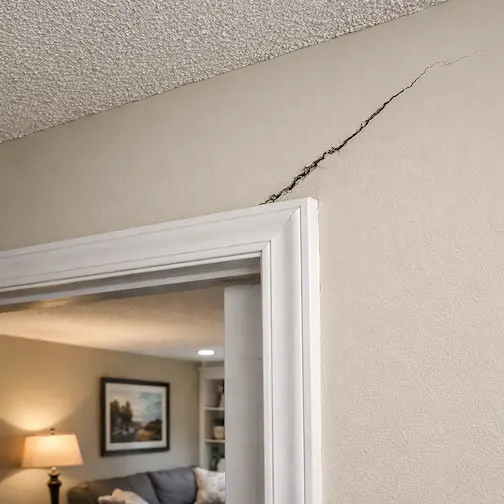
Inspection finding: Recurring diagonal drywall crack at a door frame corner in the living space above, linked during inspection to documented foundation settlement in the corresponding area of the basement.
What Our Foundation Inspection Evaluates in Detail
A complete foundation inspection covers every system and condition that affects the structural performance of your home’s foundation. Here is a detailed breakdown of each assessment category, what our inspectors are specifically looking for, and why each category matters for the overall evaluation of your foundation’s health.
Crack Pattern Analysis and Classification
Not all foundation cracks are equally significant, and the pattern, orientation, width, and location of a crack communicate specific information about the forces that produced it. Horizontal cracks in basement walls typically indicate lateral soil or hydrostatic pressure and are among the more serious crack types because they often signal that the wall has begun to bow inward under load. Diagonal cracks in poured concrete walls frequently indicate differential settlement or heave, with the diagonal direction pointing toward the area of greater movement. Stair-step cracking in concrete block walls is typically associated with settlement or lateral movement at a specific section of the wall. Vertical cracks often result from concrete shrinkage during curing and may be cosmetic rather than structural, depending on width, displacement, and the presence of associated symptoms. Our inspectors document every crack found during the inspection, classify it by type and likely cause, measure its width at multiple points, and assess whether the crack pattern and associated conditions indicate active ongoing movement or historical stabilized damage.
Foundation Settlement and Differential Movement Assessment
Foundation settlement occurs when the soil beneath the foundation footings compresses, loses bearing capacity, or erodes, allowing the foundation to sink at one or more points. Differential settlement, where one part of the foundation settles more than another, is particularly damaging because it introduces uneven stresses into the foundation walls and the structural framing above. In Northern Colorado, differential settlement is commonly associated with the behavior of expansive clay soils that swell and shrink unevenly depending on moisture distribution around the foundation. We assess settlement by mapping floor levels with a precision instrument throughout the home, examining crack patterns for the directional indicators of differential movement, looking for visible displacement at foundation wall joints and corners, and evaluating site drainage conditions that may be contributing to uneven moisture distribution in the bearing soils. The settlement assessment is one of the most important components of the inspection report because it determines whether stabilization measures are warranted and if so what type and at what locations.
Wall Bowing and Lateral Movement Evaluation
Basement walls that are bowing inward under the pressure of saturated or expansive soil are a structural condition that warrants careful assessment and typically requires intervention to prevent further movement and eventual wall failure. The degree of bow measured at the point of maximum deflection, expressed as the horizontal displacement relative to the wall height, is a key metric in determining the urgency and type of structural response required. Walls with minor bowing may be candidates for carbon fiber strap stabilization that arrests further movement without correcting the existing deflection. Walls with more significant bowing may require wall anchors, steel I-beam bracing, or in severe cases partial or full reconstruction. Our inspection measures the degree of bow at all affected wall sections, assesses whether the movement appears active or stabilized, and provides a clear recommendation for the appropriate structural response based on the specific conditions found.
Water Intrusion and Hydrostatic Pressure Assessment
Water is one of the primary drivers of foundation deterioration in Northern Colorado. It erodes soil bearing capacity, contributes to the expansive soil behavior that generates lateral wall pressure, enters through cracks and joints to freeze and widen them further, and creates the hydrostatic pressure against below-grade walls that causes bowing and cracking over time. Our inspection assesses all active and historic water entry points throughout the foundation, documents the severity and frequency of water intrusion based on staining patterns, tide marks, and efflorescence deposits, evaluates the condition of any existing waterproofing measures, and identifies the site drainage deficiencies and wall condition factors that are allowing water to reach and penetrate the foundation. The water intrusion assessment is closely linked to the structural findings throughout the report because moisture and structural deterioration in a foundation are almost always interconnected.
Site Drainage and Grading Assessment
The drainage conditions around the exterior perimeter of a home are a foundational determinant of foundation health. Soil that slopes toward the home concentrates surface water against the foundation with every rain event and snowmelt period. Downspouts that discharge within a few feet of the foundation walls deliver concentrated roof runoff directly to the soil immediately adjacent to the foundation. Raised landscape beds installed against the foundation create a reservoir effect that keeps the soil near the foundation wall perpetually moister than the surrounding grade. All of these conditions contribute directly to the hydrostatic pressure, soil swelling, and erosion that drive the foundation problems visible during the structural inspection. Our site assessment documents the grading conditions around the full perimeter, evaluates downspout discharge locations and extension adequacy, identifies landscape features that are contributing to concentrated moisture near the foundation, and provides recommendations for site drainage improvements that would reduce the moisture load on the foundation going forward.
Floor Level Mapping and Settlement Pattern Analysis
Measuring floor levels throughout the home is one of the most informative tools in a foundation inspection because it provides an objective map of any settlement or heave that has occurred and reveals the pattern of movement in a way that visual inspection alone cannot fully capture. We take floor level measurements at a defined grid of points throughout the accessible living area and basement, recording the elevation at each point relative to a consistent reference. The resulting floor level map reveals the locations, directions, and relative magnitudes of any foundation movement that has translated into floor level changes. This map is a critical component of the inspection documentation because it provides a precise baseline that can be compared against future measurements to determine whether movement is ongoing and at what rate, which is essential information for decisions about the timing and urgency of repair work.
Above-Grade Structural Symptom Assessment
Foundation movement communicates itself through the structure above in ways that are systematic and interpretable once you know what to look for and how to connect the above-grade symptoms to the below-grade conditions that caused them. Diagonal drywall cracks at door and window corners point in the direction of greatest movement. Doors and windows that stick on one side and have gaps on the other indicate rotation or racking of the structural frame above a settling foundation. Gaps that form at the wall-ceiling junction typically appear on the side of the room toward which the adjacent foundation is settling. Separation between a chimney and the main structure of the house indicates that the chimney foundation is settling independently of the main foundation. We document all above-grade symptoms observed during the interior walkthrough and connect each to its corresponding foundation finding to give you a complete picture that links what you see in your living space to what is happening in the foundation below.
Vegetation and Root Influence Assessment
Large trees and shrubs planted in proximity to a home’s foundation can influence foundation conditions in multiple ways. Tree roots extract moisture from the soil in their vicinity, causing local soil shrinkage and settlement in clay soils that can produce differential foundation movement on the side of the home closest to the tree. Root systems that extend beneath the foundation can exert uplift forces as they grow. Decomposing root systems can create voids in the soil that compromise bearing capacity. We assess the species, size, and proximity of significant trees and large shrubs around the home and evaluate whether they represent a current or future risk to foundation stability. This assessment is particularly relevant in Northern Colorado neighborhoods with mature tree plantings close to homes, where root influence on expansive clay soils can be a meaningful contributor to the differential movement patterns observed during the inspection.
Why Foundation Conditions in Northern Colorado Require Specialist Evaluation
Expansive Clay Soils Are the Primary Driver of Local Foundation Problems
The expansive clay soils found throughout much of Larimer and Weld counties are the single most important factor distinguishing foundation conditions in Northern Colorado from those in regions with more stable soil profiles. These soils can change volume by ten percent or more between their wettest and driest states, generating forces against foundation walls and beneath foundation footings that are measured in thousands of pounds per square foot. The direction of these forces varies seasonally, pushing against walls during wet periods and pulling away from them during dry periods, creating a cyclical stress pattern that progressively fatigues foundation materials over years and decades. A foundation inspector who does not understand expansive clay soil behavior and its specific manifestations in this region cannot accurately interpret the crack patterns, floor level changes, and wall deflection measurements they observe. Our inspectors evaluate every finding in the context of what Northern Colorado’s soil conditions produce so that recommendations are grounded in local reality rather than generic national standards.
General Home Inspections Are Not Sufficient for Foundation Assessment
A general home inspection covers a broad scope of home systems in a limited time and is designed to identify obvious deficiencies rather than to provide the depth of structural analysis that a foundation assessment requires. General home inspectors typically note visible cracks and recommend further evaluation by a specialist, but they do not measure crack widths and document crack patterns, map floor levels, assess wall bowing with appropriate instruments, evaluate site drainage comprehensively, or connect above-grade symptoms to specific below-grade conditions in the way that a specialist foundation inspection does. For buyers and sellers in the Fort Collins real estate market, relying on a general home inspection alone for foundation assessment means making decisions with incomplete information about one of the most structurally and financially significant aspects of the property. A specialist foundation inspection from Fort Collins Foundation Repair provides the depth and accuracy that foundation decisions genuinely require.
Early Detection Dramatically Expands Repair Options and Reduces Costs
The range of repair options available for a foundation problem shrinks as the problem advances, and the cost of repair increases substantially at each stage of progression. A basement wall that is showing the early signs of lateral pressure with minor cracking and no measurable bow may be addressable with carbon fiber strap stabilization and drainage improvements at relatively modest cost. The same wall, inspected years later after the bow has advanced beyond a correctable threshold, may require far more invasive and expensive structural intervention or even partial reconstruction. The same progression applies to settlement, where early stabilization with underpinning piers at a limited number of locations may adequately address what would later require a much larger scope of pier installation as the settlement spreads. A professional foundation inspection conducted at the first signs of potential problems, rather than after visible symptoms have become significant, consistently produces the best outcomes both structurally and financially for Northern Colorado homeowners.
Your Foundation Deserves a Professional Assessment, Not Guesswork
The foundation beneath your home is not a system you can afford to monitor casually or assess informally. The expansive clay soils, freeze-thaw cycles, and moisture conditions that Northern Colorado foundations contend with year after year produce problems that require specialist eyes, appropriate instruments, and deep local knowledge to evaluate accurately. Fort Collins Foundation Repair provides thorough, documented foundation inspections that give you the complete, honest picture of your foundation’s current condition, what is causing what you see, and what level of response it warrants. The inspection is free. There is no obligation to proceed with any repair work. And the information you receive is the most valuable first step any homeowner dealing with foundation concerns can take. Fill out the form above and let our team assess your foundation properly.
Contact Us to Schedule Your Free Foundation Inspection