Crawl Space Inspection in Fort Collins & Northern Colorado
Most homeowners go years, sometimes decades, without ever accessing or inspecting the crawl space beneath their home. What is happening in that space during those years does not stay contained below the floor. Moisture migrates upward into structural framing. Mold colonizes wood surfaces and insulation. Pests establish themselves in undisturbed spaces where they are free to cause damage without detection. Structural members absorb moisture, swell, compress, and gradually lose the load-bearing capacity the floor system depends on. And all of it occurs in a space that is easy to ignore precisely because it is out of sight and out of mind.
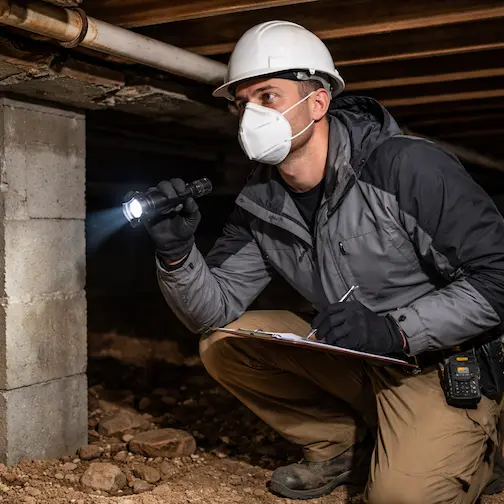
A professional crawl space inspection brings complete visibility to what is happening beneath your home. At Fort Collins Foundation Repair, our crawl space inspection service is a thorough, documented assessment of every condition present in the below-floor space, conducted by experienced professionals who know what to look for and how to interpret what they find in the context of Northern Colorado’s specific soil conditions, climate demands, and construction practices. We do not perform drive-by assessments or quick visual scans from the access hatch. We enter the space, move through it systematically, measure conditions with calibrated instruments, document everything found, and provide you with a complete picture of what your crawl space looks like right now and what it needs going forward.
We serve homeowners throughout Fort Collins, Loveland, Greeley, Windsor, Wellington, Timnath, and the surrounding communities of Larimer and Weld counties. Whether you are a long-term homeowner who has never had a crawl space inspection, a buyer or seller in a real estate transaction, or a homeowner responding to symptoms that suggest something is wrong beneath the floor, our inspection service gives you the information you need to make confident, well-informed decisions about your home.
Why Every Northern Colorado Homeowner Needs a Professional Crawl Space Inspection
The crawl space beneath a home in the Fort Collins area operates in one of the most demanding below-floor environments in the region. Clay-dominant soils that retain moisture for extended periods, spring snowmelt that saturates the ground for weeks at a time, summer irrigation that keeps soil moisture elevated through the warm season, and significant temperature swings between seasons all combine to create conditions that accelerate the deterioration of every material present in an unprotected crawl space. Understanding the actual state of conditions beneath your home is not a luxury. It is essential maintenance information that affects structural safety, indoor air quality, energy performance, and long-term property value.
Many of the most serious crawl space problems develop entirely without visible symptoms in the living space above until the damage is already extensive. Wood rot in floor joists progresses silently for years before soft spots or floor deflection become detectable from above. Mold colonizes insulation and framing while the only detectable sign in the living area is a faint musty odor that is easy to attribute to other sources. Pest infestations establish themselves and cause structural damage long before any evidence migrates above the floor level. By the time these problems become obvious from the living space, the repair cost is typically many times what early detection and intervention would have required.
A professional crawl space inspection eliminates the uncertainty about what is happening beneath your home. It provides documented, accurate information about the current condition of your structural wood, your moisture control systems, your insulation, your drainage situation, and every other aspect of crawl space health. That information is the foundation for every maintenance and repair decision that follows, and it is far more valuable than proceeding on assumptions that may be significantly wrong.
Whether your home has never been inspected below the floor, whether you are responding to symptoms that concern you, or whether you are preparing to buy or sell a property, a thorough crawl space inspection from Fort Collins Foundation Repair gives you the complete, accurate picture your decisions deserve.
When You Should Schedule a Crawl Space Inspection
- You have never had a professional crawl space inspection since purchasing or building the home
- You are buying or selling a home and want an independent assessment of below-floor conditions
- You have noticed musty or earthy odors in the living area that persist despite surface cleaning
- Floors feel soft, springy, or uneven in areas above the crawl space
- Indoor humidity levels seem persistently elevated without a clear explanation
- Energy bills have increased without a corresponding change in usage patterns
- Floors are cold in winter despite adequate heating system operation
- You have experienced any plumbing leaks beneath the floor that may have introduced moisture
- You know or suspect that pest activity has occurred in the crawl space
- The home has experienced significant flooding or water intrusion at any point
- The crawl space has not been accessed in more than two years
- You are planning a renovation that involves the floor system or crawl space area
- A previous inspection identified issues and you want to verify current conditions or confirm that repairs are performing as intended
In many of these situations, early inspection and detection allows problems to be addressed at a fraction of the cost of repair once they have progressed. The investment in a professional inspection is consistently the most cost-effective first step available.
Schedule Your Free Crawl Space Inspection
Fill out the secure form below to request your free crawl space inspection. Our team will contact you promptly to schedule a convenient time to assess your crawl space from access hatch to every corner of the below-floor space. We document all findings, measure conditions with calibrated instruments, and provide you with a complete written summary of what we found and what we recommend. There is no cost and no obligation involved.
What Our Crawl Space Inspection Covers, Step by Step
A thorough crawl space inspection is a systematic process that moves through every area of the below-floor space in a defined sequence, assessing each category of conditions with appropriate tools and an informed understanding of what normal and abnormal conditions look like. Our inspectors do not stand at the access hatch and visually scan what they can see from the opening. They enter the crawl space fully, move through its entire footprint, and evaluate every structural member, every square foot of moisture control material, every drainage component, and every environmental condition they encounter.
The inspection process is informed by our deep familiarity with the specific conditions and construction practices common to homes throughout the Fort Collins area. We know what construction eras and home types in this region are most likely to present specific problems. We know what the clay soil conditions beneath Northern Colorado homes produce in terms of moisture behavior at different times of year. And we know how to distinguish conditions that require prompt attention from those that are within normal range for the local environment and can be monitored rather than immediately repaired.
Every inspection concludes with a written summary of findings organized by category, including photographs documenting conditions found throughout the space, instrument readings for moisture content and relative humidity, and clear recommendations for any repairs, improvements, or monitoring that the findings warrant. We walk you through the report in person and answer every question you have about what was found and what it means for your home.
Our goal is not to alarm you or to generate repair business by overstating problems. Our goal is to give you accurate information so you can make informed decisions. If your crawl space is in good condition, we tell you that. If it has problems that need attention, we describe them clearly, prioritize them honestly, and give you the information you need to address them in the right sequence and at the right time.
- Pre-inspection homeowner consultation: Discuss any symptoms or concerns you have noticed from the living space, the history of the home’s crawl space, any previous repairs or inspections, and any specific questions you want the inspection to address. This context helps focus the inspection on areas of particular concern in addition to the standard assessment protocol.
- Access hatch and entry point assessment: Evaluate the condition, size, and sealing of the crawl space access hatch or entry point, noting whether it provides an adequate pathway for service access and whether it contributes to air or moisture infiltration between the crawl space and the conditioned living area.
- Ambient conditions measurement: Record relative humidity, temperature, and where instruments permit, radon concentration levels within the crawl space at multiple locations. Document outdoor conditions at the time of inspection for context. These baseline measurements establish the environmental conditions present on the day of inspection and provide a benchmark for comparison at future inspections.
- Vapor barrier assessment: Evaluate the condition, coverage, thickness, seam integrity, and perimeter attachment of any existing vapor barrier installation. Note areas of displacement, tearing, puncture, pooled water beneath the barrier, or sections where the barrier is absent. Assess whether the existing barrier specification is adequate for the moisture load present in this crawl space environment.
- Structural wood moisture content measurement: Use a calibrated moisture meter to measure the moisture content of floor joists, rim joists, sill plates, beams, and support posts at multiple locations throughout the crawl space. Document readings and compare against safe thresholds to identify areas where moisture absorption has reached levels that support fungal decay or that indicate chronic moisture exposure requiring intervention.
- Structural condition assessment: Visually and physically assess all accessible floor joists, rim joists, sill plates, center beams, and support posts for rot, fungal growth, insect damage, physical damage, and loss of structural integrity. Probe suspect areas with an awl or probe tool to detect soft or punky wood beneath surfaces that may appear intact. Note the location, extent, and severity of any structural compromise found.
- Mold and fungal growth assessment: Identify and document any visible mold growth, surface fungal colonization, or staining patterns consistent with biological activity on wood surfaces, insulation, and other materials throughout the crawl space. Note the type, location, and estimated extent of any growth found and assess whether conditions present are currently conducive to continued or expanded biological activity.
- Insulation assessment: Evaluate the condition, coverage, and effectiveness of any insulation present in the crawl space. Note sections that are wet, compressed, displaced, or fallen from between the joists. Assess whether the insulation type and placement are appropriate for the crawl space configuration and moisture conditions present.
- Drainage and water intrusion assessment: Identify all locations where water enters or has entered the crawl space, including foundation wall cracks, the floor-wall joint, the slab surface, and through-wall penetrations. Assess the performance of any existing drainage channels, sump pit, or pump. Document standing water, saturated soil areas, water staining, and tide marks that indicate the level and frequency of past water intrusion events.
- Foundation vent and air infiltration assessment: Evaluate the location, condition, and sealing status of all foundation vents and other air infiltration pathways including the rim joist area, penetrations for pipes and conduits, and the access hatch perimeter. Assess whether the current ventilation approach is appropriate for the crawl space conditions present and whether air infiltration pathways are contributing to moisture or temperature problems in the space.
- Documentation, written report, and homeowner walkthrough: Compile all findings into a written inspection report organized by category, including photographs of all notable conditions found, instrument readings, and prioritized recommendations. Walk the homeowner through the report, explain every finding in plain language, answer all questions, and provide clear guidance on recommended next steps in order of urgency and importance.
You cannot make good decisions about your crawl space without accurate information about what is actually happening in it. A professional inspection from Fort Collins Foundation Repair gives you a complete, documented picture of conditions beneath your home so every decision you make going forward is based on facts rather than assumptions. The inspection is free and there is no obligation to proceed with any repair work.
Schedule Your Free Crawl Space InspectionCrawl Space Inspections Across Fort Collins & Northern Colorado
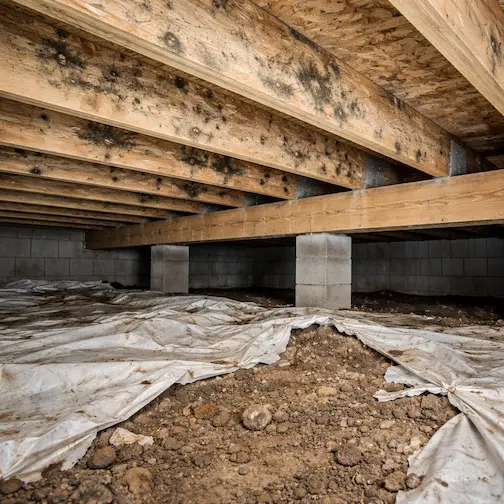
Inspection finding: Extensive mold growth on floor joists and subfloor sheathing combined with a fully failed vapor barrier and saturated soil conditions in a Fort Collins home.
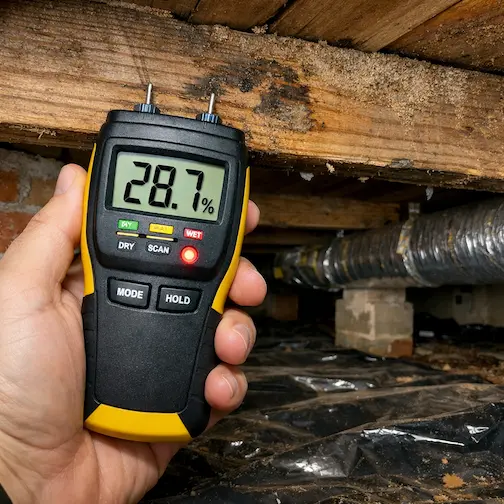
Inspection finding: Moisture meter readings indicating wood moisture content above safe thresholds in multiple floor joists, with no visible surface deterioration detectable from the living space above.
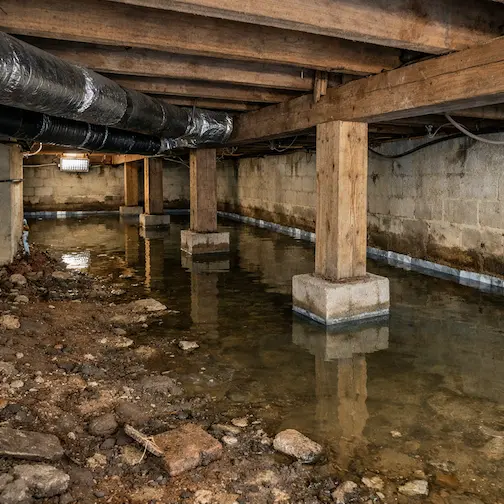
Inspection finding: Standing water along the full perimeter of the crawl space floor following spring snowmelt, with tide marks on foundation walls indicating repeated seasonal flooding at this level.
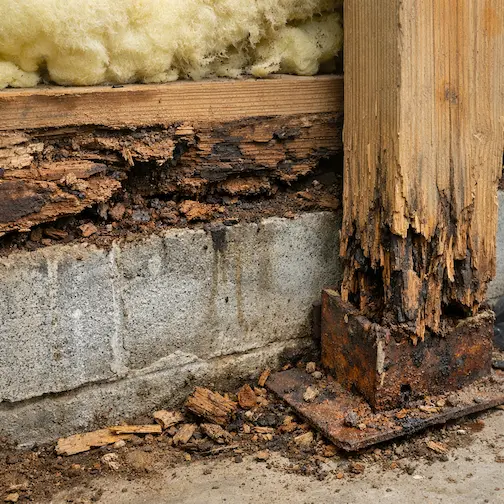
Inspection finding: Severely rotted sill plate at the foundation wall connection and a support post compromised at its base, with no visible indication of structural problems in the floor above.
What Our Inspection Evaluates in Detail
A complete crawl space inspection covers every system and material present in the below-floor space. Here is a detailed breakdown of each assessment category, what we are looking for within it, and why it matters for your home’s performance and safety.
Structural Wood Assessment
The structural framing of the floor system is the most consequential category in any crawl space inspection. Floor joists, rim joists, sill plates, center beams, and support posts all bear the loads transmitted from the living space above and must maintain their structural integrity throughout the life of the home. We assess every accessible structural member visually and physically, probing suspect areas to detect soft or punky wood that may appear intact on the surface but has lost structural capacity internally. We measure wood moisture content with a calibrated meter at multiple locations and compare readings against the thresholds at which fungal decay becomes active and at which wood begins absorbing moisture at a rate that compromises its dimensional stability. Any structural compromise found is documented with photographs, location notes, and an assessment of severity that informs the prioritization of recommended repairs.
Moisture and Water Intrusion Assessment
Water and moisture are the primary drivers of nearly every problem that develops in a crawl space over time, and understanding how moisture is behaving in the space is central to every inspection we conduct. We record ambient relative humidity at multiple locations throughout the crawl space and compare readings against safe thresholds. We identify all active and historic water entry points, including cracks in foundation walls, the floor-wall cold joint, through-wall penetrations, and areas of the soil floor where groundwater seepage is occurring. We look for tide marks, water staining, efflorescence, and sediment deposits that reveal the history of water intrusion events even when the space is dry at the time of the inspection. Standing water and saturated soil areas are documented with precise location notes. The sum of these moisture observations provides a complete picture of the water management situation in the crawl space and the severity of the problem that moisture control repairs will need to address.
Vapor Barrier Condition Assessment
The vapor barrier is the primary defense against soil moisture vapor entering the crawl space environment, and its condition has a direct impact on everything else in the space. We assess the full coverage, thickness, material specification, seam integrity, and perimeter attachment of any existing vapor barrier across the entire crawl space footprint. We note areas where the barrier is absent, displaced, torn, punctured, or bridged over obstructions in ways that create effective gaps in coverage. We look beneath the barrier where accessible to assess whether water is pooling underneath it, which indicates that the barrier is managing moisture that should be addressed by drainage before the barrier can perform optimally. The condition assessment of the vapor barrier provides the baseline for recommendations about repair, replacement, or upgrade to a higher-specification system appropriate for the conditions found.
Mold and Biological Growth Assessment
Mold and fungal growth in a crawl space is both a structural concern and an air quality concern, and identifying its presence, extent, and likely cause is an important component of every inspection we conduct. We visually assess all accessible surfaces for mold growth, surface fungal colonization, and the dark staining patterns that indicate current or historical biological activity. We note the location, approximate coverage area, and visual characteristics of any growth found. We also assess the current humidity and moisture conditions in the affected areas to determine whether conditions are actively conducive to continued mold growth or whether the growth observed is historical and the conditions that caused it have since changed. This distinction matters for repair recommendations because active mold growth in favorable conditions requires both treatment and the elimination of the moisture source, while historical staining in a now-dry environment may require only treatment without the same urgency around moisture control improvements.
Insulation Condition and Coverage Assessment
Insulation in a crawl space serves both thermal and moisture management functions, and its condition and placement significantly affect both the energy performance and the moisture dynamics of the below-floor space. We assess the type, thickness, coverage, and condition of all insulation present in the crawl space, whether installed between floor joists, on foundation walls, at the rim joist, or in some combination. We note sections that are wet, compressed, displaced from between the joists, or fallen to the crawl space floor. We identify areas where insulation is absent that should be covered based on the configuration of the space and the climate requirements of the Northern Colorado region. We assess whether the insulation type and placement are appropriate for the current or intended crawl space configuration, noting for example whether fiberglass batts installed between joists in a vented crawl space would be better replaced with wall insulation as part of a transition to an encapsulated configuration.
Drainage System Assessment
Where a drainage system is present in the crawl space, we assess its condition, coverage, and current performance. We evaluate any perimeter drainage channels for blockage, displacement, or damage. We inspect the sump pit for condition, water level, debris accumulation, and cover integrity. We assess the sump pump for operational status, float switch function, discharge line integrity, and whether the pump capacity is adequate for the water volumes the space experiences during peak moisture periods. Where no drainage system is present but water intrusion evidence indicates that one is warranted, we note this finding and include it in the recommended scope of remediation work. For homes in the Fort Collins area where spring snowmelt regularly introduces significant water volumes into crawl spaces without adequate drainage, the drainage system assessment is one of the most important components of the inspection report.
Ventilation and Air Infiltration Assessment
The ventilation strategy used in a crawl space, whether vented or sealed, has profound implications for moisture conditions, temperature stability, and energy performance. We assess all foundation vents for their location, size, condition, and whether they are open, screened, or sealed. We evaluate the rim joist for insulation coverage and air sealing status. We identify other air infiltration pathways including gaps around pipes, conduits, and the access hatch perimeter. We assess whether the current ventilation approach is appropriate for the conditions found in the space and consistent with current building science recommendations for the Northern Colorado climate. For homes with open vented crawl spaces showing moisture problems consistent with outdoor air condensation, our inspection report will clearly communicate the case for transitioning to an encapsulated configuration and outline the scope of work that transition would involve.
Pest and Wildlife Activity Assessment
Crawl spaces are attractive habitats for rodents, insects, and other wildlife, and the damage they cause can be significant and rapid once they have established themselves in the space. We assess the crawl space for evidence of rodent activity including droppings, nesting material, gnawed insulation and vapor barrier, and gnawed wood structural members. We look for evidence of wood-destroying insect activity including the mud tubes characteristic of subterranean termites, the frass and exit holes associated with carpenter ant or wood-boring beetle activity, and the structural damage patterns these insects produce. We note any entry points through the foundation or crawl space enclosure through which pests may be accessing the space. Pest-related findings are documented clearly in the inspection report with photographs and specific location notes, as they often require coordination between structural repair work and pest control services.
Why Crawl Space Inspections Are Particularly Important in Northern Colorado
Problems Develop Faster Here Than in Drier Climates
The combination of clay soils, spring snowmelt saturation, summer irrigation, and significant temperature swings creates a crawl space environment in Northern Colorado that is more moisture-aggressive than what homes in drier western climates experience. Conditions that might take a decade to cause significant structural damage in a low-moisture environment can produce the same level of deterioration in a fraction of that time when soil moisture and humidity levels are persistently elevated. This accelerated deterioration timeline means that inspection intervals that might be adequate in other regions are insufficient for homes in the Fort Collins area. A crawl space that was in acceptable condition two or three years ago may present significantly different conditions today if moisture management has been inadequate in the intervening period.
Spring Is the Most Critical Inspection Window
The period immediately following spring snowmelt, typically April through early June in the Fort Collins area, is the most revealing time of year to inspect a crawl space because it captures conditions at or near their annual peak. Water table elevations are at their highest. Soil moisture saturation is at its maximum. Any water intrusion pathways that are active under stress conditions will be visible. Any drainage system deficiencies will be apparent. And the cumulative moisture impact of the preceding winter on structural wood and insulation will be measurable. A spring inspection captures the worst-case annual conditions and provides the most complete picture of how the crawl space performs under maximum stress. For homeowners who have never had an inspection or who have experienced any indication of moisture issues, scheduling an inspection during or immediately after the spring thaw period is the most informative time to do so.
Pre-Purchase Inspections Are Essential in This Market
Real estate transactions in the Fort Collins and Northern Colorado market move quickly, and crawl space conditions are frequently not covered in adequate depth by standard home inspections. A general home inspector may enter the crawl space access hatch and note obvious visible conditions, but the systematic assessment, instrument-based measurements, and informed local interpretation that a specialist crawl space inspection provides are typically beyond the scope of a general home inspection. Buyers who discover significant crawl space problems after closing on a Northern Colorado property often find that the repairs required are far more extensive and expensive than what the purchase price reflected. A pre-purchase specialist crawl space inspection from Fort Collins Foundation Repair provides the detailed, documented information that buyers need to negotiate accurately and make fully informed decisions before committing to a purchase.
Know What Is Beneath Your Home Before It Becomes a Problem
The crawl space beneath your Fort Collins area home is not a space you can afford to leave uninspected and unmonitored. The conditions developing there right now, whether moisture accumulation, structural deterioration, mold colonization, or pest activity, will not resolve on their own and will not stay contained below the floor indefinitely. They will find their way into the structure, the air quality, the energy performance, and eventually the visible condition of your home. Fort Collins Foundation Repair provides thorough, documented crawl space inspections conducted by professionals who know Northern Colorado’s specific conditions and know how to interpret what they find. The inspection is free, there is no obligation to proceed with any work, and the information you receive gives you the complete, accurate picture of your crawl space that every informed homeowner deserves to have. Fill out the form above to schedule your inspection today.
Contact Us to Schedule Your Free Crawl Space Inspection