Basement Drainage Systems in Fort Collins & Northern Colorado
Standing water in your basement is not just an inconvenience. It is a signal that your home’s drainage system is failing to manage the water load being placed on it, and that failure will compound with every rain event and every spring thaw until a proper drainage solution is in place. At Fort Collins Foundation Repair, we design and install complete basement drainage systems that capture water at its entry point, route it safely through a controlled pathway, and remove it from your home before it can cause structural damage, mold growth, or long-term deterioration of your foundation and finishing materials.
Our basement drainage systems are engineered specifically for the conditions that homes in Northern Colorado face. The combination of spring snowmelt that saturates soils for weeks at a time, expansive clay soils that direct water toward foundations rather than absorbing it, and intense summer storm events that overwhelm surface drainage all contribute to a basement water environment that demands a robust, permanent solution rather than temporary fixes or surface-level treatments.
We serve homeowners throughout Fort Collins, Loveland, Greeley, Windsor, Wellington, Timnath, and the surrounding communities of Larimer and Weld counties. Whether you are dealing with occasional seasonal flooding or chronic water intrusion that has persisted for years, our team has the expertise and the right system components to solve the problem permanently.
Why a Proper Drainage System Is Essential for Northern Colorado Basements
Water always follows the path of least resistance, and in many homes throughout the Fort Collins area, that path leads directly into the basement. Hydrostatic pressure from saturated soil pushes water through cracks, cold joints, the floor-wall joint, and even through the pores of poured concrete and concrete block walls. No wall coating or surface sealer can withstand sustained hydrostatic pressure indefinitely. The only reliable long-term solution is a drainage system that intercepts that water and gives it a controlled path to exit the building before it causes damage.
A properly designed basement drainage system does not attempt to stop water from entering the foundation wall. Instead, it accepts the reality that water will find a way through and manages that water systematically. Perimeter drainage channels collect water as it enters at the floor-wall joint and the base of the walls, interior drainage pipes carry it to a sump pit, and a sump pump actively removes it from the home. This approach is far more reliable and far more durable than any exterior or interior waterproofing product that relies on maintaining a physical barrier against water pressure.
For homes in the Fort Collins area, a complete drainage system is particularly valuable during the spring months when snowmelt keeps the water table elevated for extended periods. During these weeks, a basement without drainage is at the mercy of conditions it cannot control. A basement with a properly installed drainage system simply channels that water out of the home continuously and quietly without any intervention required.
The result is a dry basement that stays dry not just on good days, but on the worst days the Northern Colorado climate produces, giving you the confidence to use and invest in your basement space without fear of recurring water damage.
Signs Your Basement Needs a Drainage System
- Standing water on the basement floor after rain events or during spring snowmelt
- Water seeping in at the floor-wall joint around the perimeter of the basement
- Wet or damp concrete floor even without visible standing water
- Visible water staining or tide marks on walls or floor indicating past flooding
- Mold, mildew, or musty odors that persist despite cleaning
- Rust staining on metal objects stored in the basement
- Efflorescence deposits on walls or floor indicating chronic moisture migration
- Damaged or warped flooring materials in finished basement areas
- A sump pit that fills rapidly or a sump pump that runs continuously during wet periods
- Water intrusion that occurs seasonally and has been accepted as a recurring problem
- Finished basement areas that have experienced repeated water damage to drywall or flooring
Any of these signs indicate that water is entering your basement in volumes that your current drainage situation cannot handle. A complete drainage system installation addresses the root cause rather than managing the symptoms on an ongoing basis.
Get a Free Basement Drainage System Estimate
Fill out the secure form below to request your free basement drainage evaluation. Our team will assess your basement’s water intrusion sources, evaluate your existing drainage situation, and recommend the most effective drainage system solution for your home. There is no cost and no obligation involved in getting started.
Our Basement Drainage System Installation Process
Installing a basement drainage system is a significant undertaking that requires careful planning, precise execution, and a thorough understanding of how water is behaving in and around your specific foundation. Our installation process is designed to address every element of your basement’s water management challenge in the correct sequence, ensuring that the completed system functions as a fully integrated solution that performs reliably through every season Northern Colorado produces.
Every installation begins with a detailed diagnostic assessment of your basement and the surrounding site conditions. We identify where water is entering, at what volume, under what conditions, and what path it takes once it is inside. We evaluate the existing drainage situation including any sump pit or pump that may already be in place, the condition of the floor slab, the wall construction type, and any exterior grading or downspout drainage issues that may be contributing to the problem. That assessment informs every component selection and placement decision in the installation that follows.
Our installation teams are experienced with the specific soil conditions, construction types, and water behavior patterns common to homes throughout the Fort Collins area. That local familiarity means the system we design for your basement reflects an understanding of the real conditions it will need to manage, not just a generic drainage template applied without consideration of your property’s specific characteristics.
When the installation is complete, we do not simply hand you a receipt and leave. We test the system, walk you through how it works, explain how to monitor it, and make sure you understand exactly what has been installed and what it will do for your basement going forward.
- Comprehensive site and basement assessment: Identify all water entry points, evaluate soil drainage conditions, assess existing sump infrastructure, and document the full scope of the moisture problem.
- System design and layout planning: Determine the optimal routing of drainage channels, placement of sump pit or pits, discharge line routing, and any supplemental components needed for complete water management.
- Concrete saw cutting: Cut a precise channel in the perimeter of the basement floor slab along the floor-wall joint to accommodate the drainage pipe and aggregate bed.
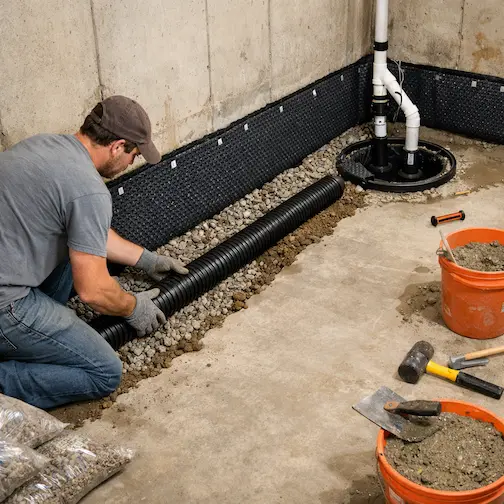
- Excavation of drainage trench: Remove concrete and excavate a trench of appropriate depth around the perimeter, providing a bed for the drainage pipe and gravel that allows water to flow freely toward the sump pit.
- Drainage pipe and aggregate installation: Place perforated drainage pipe in a gravel bed along the full perimeter trench, ensuring correct slope toward the sump pit for gravity-assisted water flow.
- Sump pit excavation and liner installation: Excavate and install a properly sized sump pit liner at the collection point of the drainage system, sized to accommodate the expected water volume and sump pump equipment.
- Sump pump installation and discharge line routing: Install primary sump pump in the pit and route the discharge line to a safe exterior discharge point well away from the foundation. Install battery backup pump where appropriate.
- Concrete restoration: Pour new concrete over the drainage trench to restore the floor slab surface, leaving a clean finished appearance that gives no indication of the drainage system running beneath it.
- System testing and homeowner walkthrough: Test all drainage components and sump pump operation, verify discharge line performance, and walk the homeowner through the complete system with a clear explanation of ongoing monitoring and maintenance.
Surface treatments and paint-on waterproofing products cannot withstand the sustained hydrostatic pressure that Northern Colorado’s spring snowmelt and clay soils generate. A complete interior drainage system from Fort Collins Foundation Repair gives water a permanent, controlled path out of your home so it never has the chance to cause damage in the first place.
Schedule Your Free Basement Drainage EvaluationBasement Drainage System Projects in Fort Collins & Northern Colorado
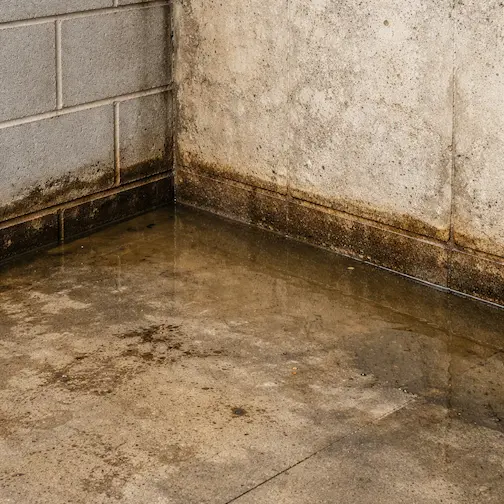
Standing water along the perimeter floor-wall joint with visible tide marks from repeated seasonal flooding.
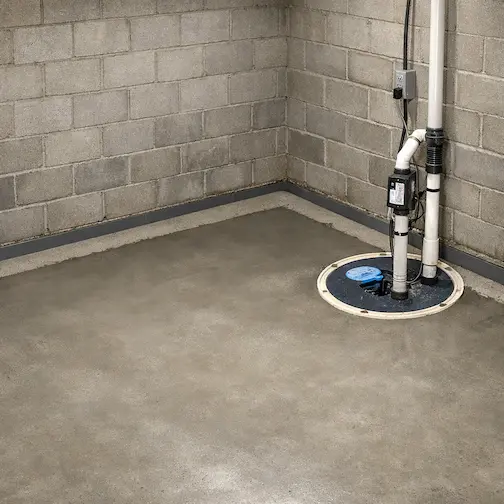
Complete interior perimeter drainage system with sump pump installed and concrete floor fully restored.
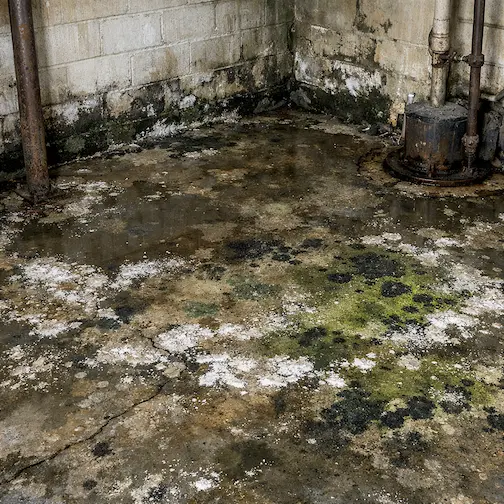
Chronically damp basement floor with mold growth and efflorescence from years of unmanaged moisture intrusion.
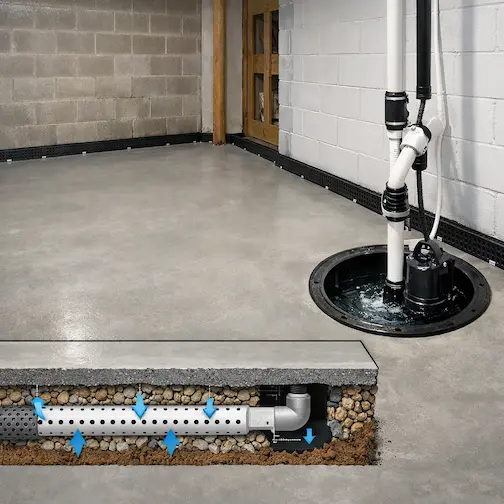
Dry, clean basement floor with drainage system operating beneath the restored concrete slab and sump pump actively managing groundwater.
Complete Basement Drainage System Components
A complete basement drainage system is made up of several components that work together as an integrated water management solution. Each element serves a specific function in the process of capturing, routing, collecting, and removing water from your basement. Here is a detailed look at every component we install and why each one matters for homes in the Fort Collins area.
Interior Perimeter Drainage Pipe
The perforated drainage pipe is the backbone of the interior drainage system. Installed in a gravel-filled trench beneath the basement floor slab around the full perimeter of the basement, the pipe intercepts water as it enters at the floor-wall joint and the base of the foundation walls and channels it toward the sump pit via gravity flow. The pipe is sized and sloped appropriately for the water volume expected based on the size of the basement and the severity of the water intrusion conditions. We use durable pipe materials appropriate for below-slab installation and surround the pipe with clean washed aggregate that allows water to move freely into the drainage pathway without the fine soil particles that would eventually clog a pipe installed without proper filtration.
Perimeter Baseboard Drainage Channel
In addition to or in place of a below-slab drainage pipe in certain configurations, a perimeter baseboard drainage channel is installed at the floor-wall joint. This channel sits at the base of the wall and captures water that seeps through the wall face or enters at the cold joint between the wall footing and the floor slab. The channel directs this water along the perimeter of the basement toward the sump pit without allowing it to spread across the floor. The baseboard channel approach is particularly effective in basements where saw-cutting the full perimeter slab is not practical or where wall seepage is the primary water entry source rather than floor-level intrusion. In many installations we use both the below-slab pipe and the baseboard channel together for comprehensive coverage of all potential water entry pathways.
Sump Pit and Liner
The sump pit is the collection point of the entire drainage system. It is excavated at the lowest natural point of the basement or at the most hydraulically advantageous location given the drainage pipe routing, and lined with a durable perforated or solid liner that provides a clean, stable vessel for water collection. Pit sizing is determined by the expected water inflow volume. An undersized pit will overflow during high-volume water events, while an adequately sized pit gives the sump pump sufficient capacity to operate efficiently without cycling on and off excessively. We install airtight pit covers that reduce humidity contribution from the pit to the basement air and prevent debris from falling into the pit and fouling the pump intake.
Primary Sump Pump
The sump pump is the active component of the drainage system, the element that physically removes collected water from the basement and discharges it away from the home. We install quality submersible or pedestal sump pumps selected for the specific demands of your basement’s water volume and the length and elevation change of the discharge line. Pump selection matters significantly in Northern Colorado, where spring snowmelt can produce sustained high-volume water inflow that taxes an underpowered pump continuously for days or weeks at a time. The pump is connected to a float switch that activates it automatically when water in the pit reaches a set level, ensuring continuous operation without any manual intervention required.
Battery Backup Sump Pump
Fort Collins experiences its most significant water intrusion events during spring snowmelt and summer thunderstorm season, and these same weather events are frequent causes of power outages. A primary sump pump that loses power during the exact moment it is needed most provides no protection at all. A battery backup sump pump installed alongside the primary unit ensures that the system continues operating during power outages, providing continuous water removal for hours even without grid power. For homeowners who have experienced basement flooding in the past or who are investing in a finished basement, a battery backup pump is a critical component of a complete and reliable drainage system.
Discharge Line and Exterior Outlet
Water collected by the sump pump must be discharged to a location outside the home that is far enough from the foundation to prevent it from immediately percolating back into the soil adjacent to your basement walls. We route the discharge line through the rim joist or foundation wall to an exterior outlet positioned to carry water well away from the home. The outlet is fitted with a freeze-resistant cover appropriate for Northern Colorado’s winter temperatures to prevent the discharge line from freezing and blocking the system during cold weather pump operation. Proper discharge line routing and termination is as important as the pump itself, and it is a detail that is frequently done inadequately in less thorough installations.
High-Water Alarm
Even a properly installed drainage system with a reliable sump pump can experience unexpected conditions such as pump failure, a blocked discharge line, or an exceptionally high-volume water event that exceeds the system’s designed capacity. A high-water alarm installed in the sump pit provides an early warning when water levels are rising beyond normal operating range, giving you the opportunity to investigate and respond before water reaches the basement floor. Some alarm systems connect to your home’s Wi-Fi network and send alerts to your smartphone, which is particularly valuable for homeowners who spend significant time away from the home during the spring water season.
Why Basement Drainage Is a Priority in Fort Collins and Northern Colorado
Sustained Spring Snowmelt Saturation
Unlike rain events that come and go within hours, the spring snowmelt season in Northern Colorado can maintain elevated soil moisture and water table levels for weeks at a time. During this period, the hydrostatic pressure against basement walls and floors is sustained rather than intermittent, meaning a drainage system must be capable of operating continuously and reliably for extended stretches without failure. Homes that only experience basement water intrusion in the spring are not off the hook. That seasonal flooding causes cumulative damage that compounds year over year if a permanent drainage solution is not put in place. The appropriate response to seasonal flooding is not to manage the water after it enters but to install a system that prevents it from accumulating in the first place.
Clay Soils That Resist Drainage
Clay-heavy soils throughout the Larimer and Weld county areas have very low permeability, meaning water does not drain through them quickly. When these soils become saturated, they hold that moisture for extended periods and direct water toward the path of least resistance, which in many cases is the basement wall and floor. Exterior drainage improvements such as regrading and downspout extensions can reduce the volume of water reaching the foundation, but they cannot overcome the fundamental drainage limitations of clay soil in a high-moisture period. An interior drainage system works independently of soil permeability, capturing water that makes it to the foundation regardless of how slowly or quickly the surrounding soil drains.
Intense Summer Storm Events
Fort Collins and the surrounding Front Range communities experience intense convective thunderstorms throughout the summer months that can deliver large rainfall totals in very short time windows. These events overwhelm surface drainage, rapidly saturate soil around foundations, and generate sudden spikes in hydrostatic pressure against basement walls and floors. A basement without a drainage system may stay dry through a moderate rain but flood badly in a severe storm event. A complete interior drainage system with an adequately sized sump pump handles these sudden high-volume events by providing a clear, unobstructed pathway for water to exit the structure as fast as it enters.
Stop Managing Basement Water and Start Eliminating It
Every wet season without a proper drainage system is another opportunity for water to damage your foundation, degrade your air quality, and chip away at your home’s value. A complete basement drainage system from Fort Collins Foundation Repair gives water a permanent, controlled path out of your home before it causes damage, so your basement stays dry through spring snowmelt, summer storms, and every wet weather event in between. The first step is a free, no-obligation evaluation with our team. We assess your specific drainage situation, explain exactly what is causing the problem, and recommend the right solution for your home and your budget.
Contact Us for Your Free Drainage Evaluation